Friday, February 12, 2010

La Rioja

This city really doesn't deserve a post, I consider this to be a warning to all NEVER to come to this place.  Really, you don't need to.

I´m not sure about the precise english translation of Rioja, but I think it translates loosely to "Purgatory" on the optimistic side, or pessimistically as one of the circles of Dante´s hell. The city is fairly small, located in a basin next to some mountains around 300km from Mendoza, and once you arrive it takes a supreme effort to leave.  There is such high demand to leave La Rioja that all of the bus seats that recline into beds are booked up almost a week in advance.  


So when we arrived at 8 pm on November 17th, after a day of touring desert national parks in up to 117 degree heat and then a 4 hour busride in a beatup old bus without airconditioning, we found that our options were pretty limited.  In order to escape we had a 6 hour bus ride in front of us in a normal seat that could begin at 12am, 3am or 8am.  After much discussion and much visitation to the ticket counters of different buslines which we learned later were collectively selling tickets for the same buses, we decided to give ourselves some relief, find a hotel somewhere, and take a shower.  


By 10pm we had managed to insult one taxi driver for supposing that he would have change, and two hotelkeepers for requesting to view a hotel room and thus insinuating that their establishments might be sub-par.  But at last we had a room at the PLAZA hotel downtown, a four star establishment with a rooftop pool, a delicious continental breakfast (besides the ubiquitous awful coffee) and interior decor rivalling Motel 6.  At 10pm with the temperature still in the 90s and not a breath of wind, that pool felt great and we were the only ones in it!

Desert Parks: Ischigualasto and Talampaya


November 17th was the day of the Desert Parks for Pedro and I.  


In the morning we visitted Parque Nacional Ischigualasto, also known as Valley of the Moon due to it´s barren landscape.  In the area of the park, continental uplift of the Andes has exposed around 45 million years of sedimentation from the Triassic period.  On the western edge of the park are the oldest dark yellow rocks, in the middle of the park are grey and light pink sediment from a middle period, and to the east are the the tall red cliffs from the late triassic.  The place is a goldmine of dinosaur bones.  We took a 3.5 hour bus tour with stops to see various rock formations caused by wind erosion and such. 


 We didn´t seen any dinosaur bones on site other than in the museum, but we did see some leaf impressions and lots of cool rocks.


In the afternoon we went to Parque Nacional Talampaya.  Again a desert park with rock formations caused by wind erosion, but what was really impressive were the dramatic red canyons that were formed by fractures in the rock.  The canyon walls are vertical and around 300 feet tall, separated by 100 feet or so of flat red sand and bright green acacia-looking trees. 

 There are also a lot of yellow-flowered bushes that look a bit like scotch broom, but they have no leaves and photosynthesize through their green bark.  


At the entrance to one of the canyons of Talampaya there is an incredible series of petroglyphs from around 500AD. 


The fauna of the parks are apparently paid, because we got great photo-ops of Guanacos (look like llamas), a Condor, a Suri (looks like an emu), and a grey fox.  All throughout the desert areas we´ve visitted so far, there have been tons of small tan colored hawks (still need to find the exact name).

Sunday, December 20, 2009

Barreal

After Mendoza we headed north to the San Juan province.  After arriving at the bus station in San Juan capital and surveying our options, we decided to head to Barreal in the southwestern corner of the province.  The town of Barreal is a green oasis in the midst of rocky, mountainous desert.  The town is dotted with small orchards and alfalfa fields, however oddly enough there is no vegetation on the banks of the river Pato nearby.  It gives the impression that the land would be inhospitable even with the presence of water.

A half hours drive south of town there is a big dried mudflat, similar to the blackrock desert, called the pampas of El Leoncito.  El Leoncito is the name of the nature reserve.  On the pampas we tried out auto-velismo, which is basically a motorless go-cart with a sail attached.  The wind that day was pretty light, but there were a few good gusts to give us a taste of what riding in a wind-powered car is like. 

After enjoying the pampas for a few hours we packed up the wind-car and drove up into the mountains to one of the two observatories in Parque El Leoncito.  The observatory that we toured specializes in asteroids.  Apparently there is a doozy headed on a collision course with Earth some 900 years from now.  Although we didn't get to look through the giant telescope, we did get to look through a very powerful portable telescope.  One of the docents set up the telescope and showed us around 14 stellar objects.  One of the reasons why the observatory was built in this far corner of argentina is that it averages around 320 clear nights per year.  The night we were there was one of those clear nights, and moonless to boot.  So many stars were visible that I couldn't distinguish the milky way. 

Here are our pictures!

Monday, December 7, 2009

Natural History Museum of La Plata


This post is a bit dislocated from the chronology of our trip, but it took me a while to upload the photos...

That said, this museum in Pedro´s hometown is AWESOME.  It is the largest natural history museum in Latin America (at least it was circa 2007 when my guidebook was written) and has a very old-fashioned, 19th century feel.  The building itself is beautiful and houses hall after hall of any kind of bones you could possibly want to see.  Dinosaurs?  Check.  Giant armadillo-type creatures from the ice ages? Check.  Umpteen whale skeletons hanging above elephants, horses and giraffes?  Check.  There are cool displays of various bugs and butterflies, as well as a room that houses a collection of stuffed animals that would make darwin weep, all realistically displayed, for example the case containing a condor devouring a small goat on a rock which I assumed represented a mountain top.


Did I mention the best part?  They let you TOUCH almost everything.  My gringa head almost exploded.


click here for more pictures

Monday, November 30, 2009

Vallecitos


On Monday November 9th we wanted to get to Vallecitos, as Pedro´s friend Mono had told us that there is good hiking around there.  Because of the high altitude and "easy" access to several different peaks, a lot of mountaineers train there before climbing Aconcagua.  As there is no public transport we had to pay $100 pesos (around $25) to get picked up.  No wonder.  Vallecitos is around 12km up a winding dirt road, and is composed of five refugios (lodges) and a small ski park.  At 2800 meters (9200 feet), I´m amazed that anyone is able to make it up there during the winter.


On Monday and Tuesday nights we stayed at the Refugio San Bernardo.  It is a cool swiss chalet looking kind of building to which the proprietors are adding additional dorm rooms, slowly but surely.  We payed $45 pesos ($12ish USD) each for our bed, and $35pesos for dinner at night.  Since it was still a week or two before the beginning of high season in mid november, there were only 2-4 others staying at the same time as us, so we had a private room.


When we arrived in Vallecitos we were a bit dizzy from the altitude, and the wind was gusting 100kmph, so we only took a brief walk before retreating back to the refugio fireplace.  The picture to the left shows how the wind was blowing the snow off of the nearby peaks.


On Tuesday we ventured out to conquer a couple of the few non-threatening looking peaks nearby.  We summitted Cerro Andresito (3092m, 10,144ft) by taking an ill-advised path up a scree field.  It wasn´t actually too bad (not too loose), but Pedro was not happy and wanted to throw me off the mountain for forcing him to continue on to the next peak rather than heading back.  But it was a fairly gentle walk up a ridgeline to Cerro Arenales (3380m, 11,090ft).

From Cerro Arenales there were great views of Potrerillos in the valley below and snow-capped Andean peaks of the Cordon de Plata behind us.  We had fairly good weather, the wind had died down to gentle harrassment and luckily the snow that was falling on the mountains behind us never arrived to where we were hiking.

On Wednesday we were ready for an overnighter in the great outdoors.  The wind was still the iciest that I´ve ever encountered, but at least in the pauses we could appreciate the burning hot rays of sun.  We hiked around 1.5 or 2 km to a hanging valley called Las Veguitas (10,600 ft) about 400meters above Vallecitos.  Even though we had dumped a fair amount of weight from our packs at the refugio, it was still a very tiring slog uphill that took around an hour and 45 minutes.  We ate lunch, pitched our tent and then I crankily took a nap for an hour.  In the afternoon around 4pm we decided to hike up to another camping spot 2km further up the trail at Piedra Grande (11,650ft).  Much easier without our packs but still tiring.  We considered continuing on to camp Salto de Agua at 4300m the next day, but on hearing that there was no water and just a desolate morraine we changed plans and decided to head back towards Mendoza city.

More pictures of Vallecitos:

Las Vegas down under


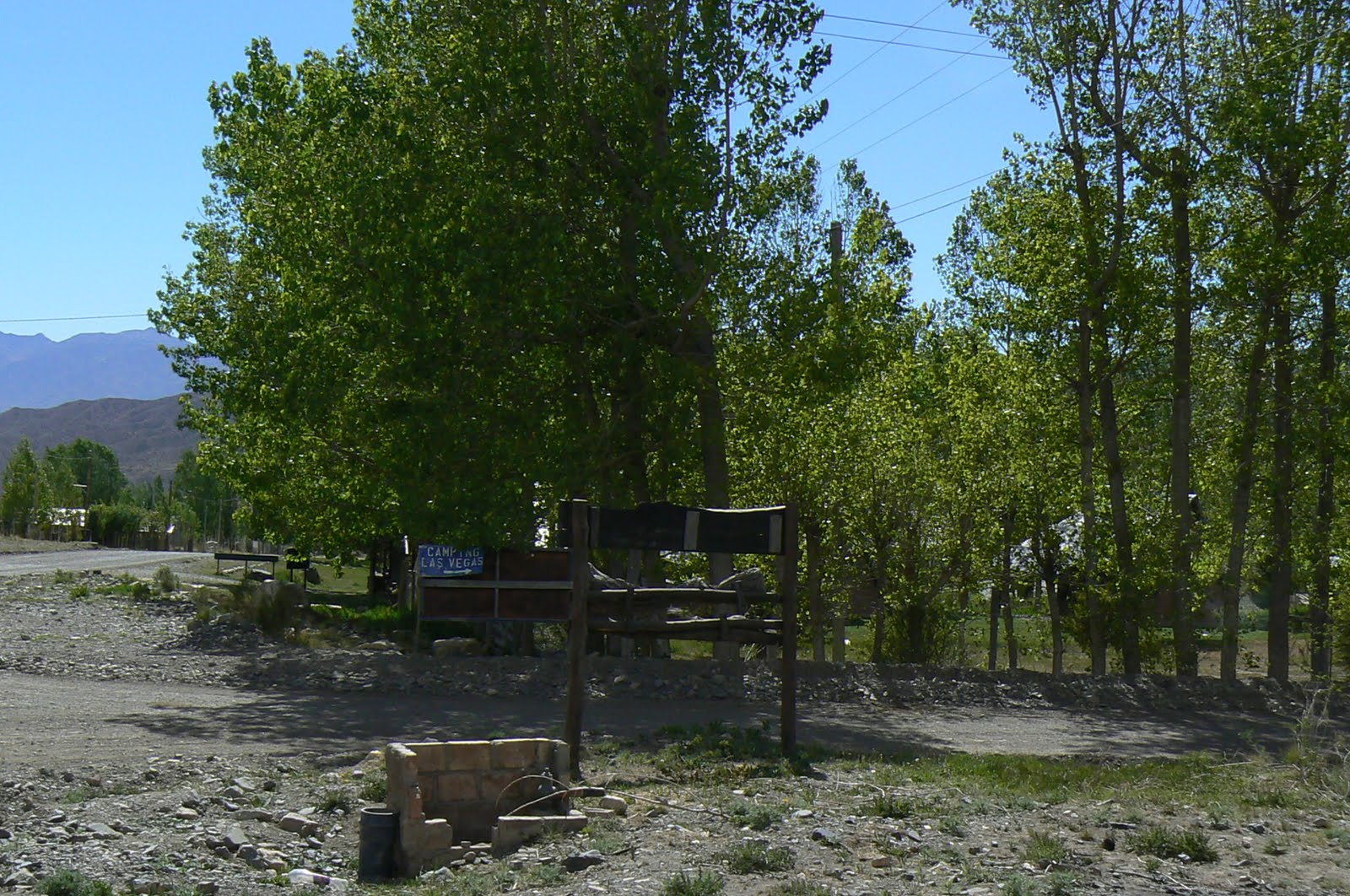
On the Sunday after we arrived in Mendoza we took a bus as far as Potrerillos in the precordillera, then hitched a ride to a campground in a bright green microbus with a couple of mendocinos who needed gas money.  On hearing that we were looking for a pretty place they brought us up to the village of Las Vegas.  Las Vegas seems to be mostly vacation rentals and a couple of Eagleville-type store/restaurants.  We went to have a submarino (hot chocolate) at one of them and Pedro was thrilled to discover an Estudiantes (his futbol team) game on a tv in the corner.  Las Vegas is situated at 1800 meters above sea level (5900 feet) so we felt a bit winded hiking around the dirt roads.  We had great views of what we assumed was Aconcagua, the highest peak in the Americas, although in retrospect a lot of these Andean peaks look alike so who knows :)


We stayed at the muncipal campground which was packed with picnic-ers during the day, but was totally empty by evening.  We camped in a beautiful meadow with a slight slope.  In the morning when we got up we enjoyed the scene of vagrant horses loping across the field.