You've got to love a province that is called Jujuy (pronounced who-hooey). The name is just fun, something you might yell at the top of a slide at Raging Waters. But Jujuy has a whole lot more going for it than just a moniker that sounds like a giggle. It has the mind-blowing Quebrada de Humauaca, a section of the Andes where God decided to take an impressionist approach to landscaping:
This is what the finished work looks like. Actually, I should say that this is NOT what the finished work looks like. The colors in real life are fantastically vivid and unfortunately amateur photography really can't do it justice. Why not?
Let's say you're driving up a mountain road. The surrounding mountains are vast and eerily shaded by deep gray storm clouds high above. But, lo, off in the distance someone must have spoken, "let there be light."
To which you reply, "Light is great and all, but could we have a little less than Hiroshima perhaps?"
And a sad little dog chimes in, "I agee."
But I digress. The Quebrada de Humauaca stretches north-south along the top of the province of Jujuy, which incidentally is shaped like a boot and shares a border with Bolivia. Sebastian, an old college friend of Pedro's, spent a weekend driving us around it at breakneck speeds, impressing us not only with the awesomeness of nature but also the awesomeness of the Chevrolet Vectra's ability to defy inertial force. Let's just say that coming out of every curve I had to blink several times in amazement.
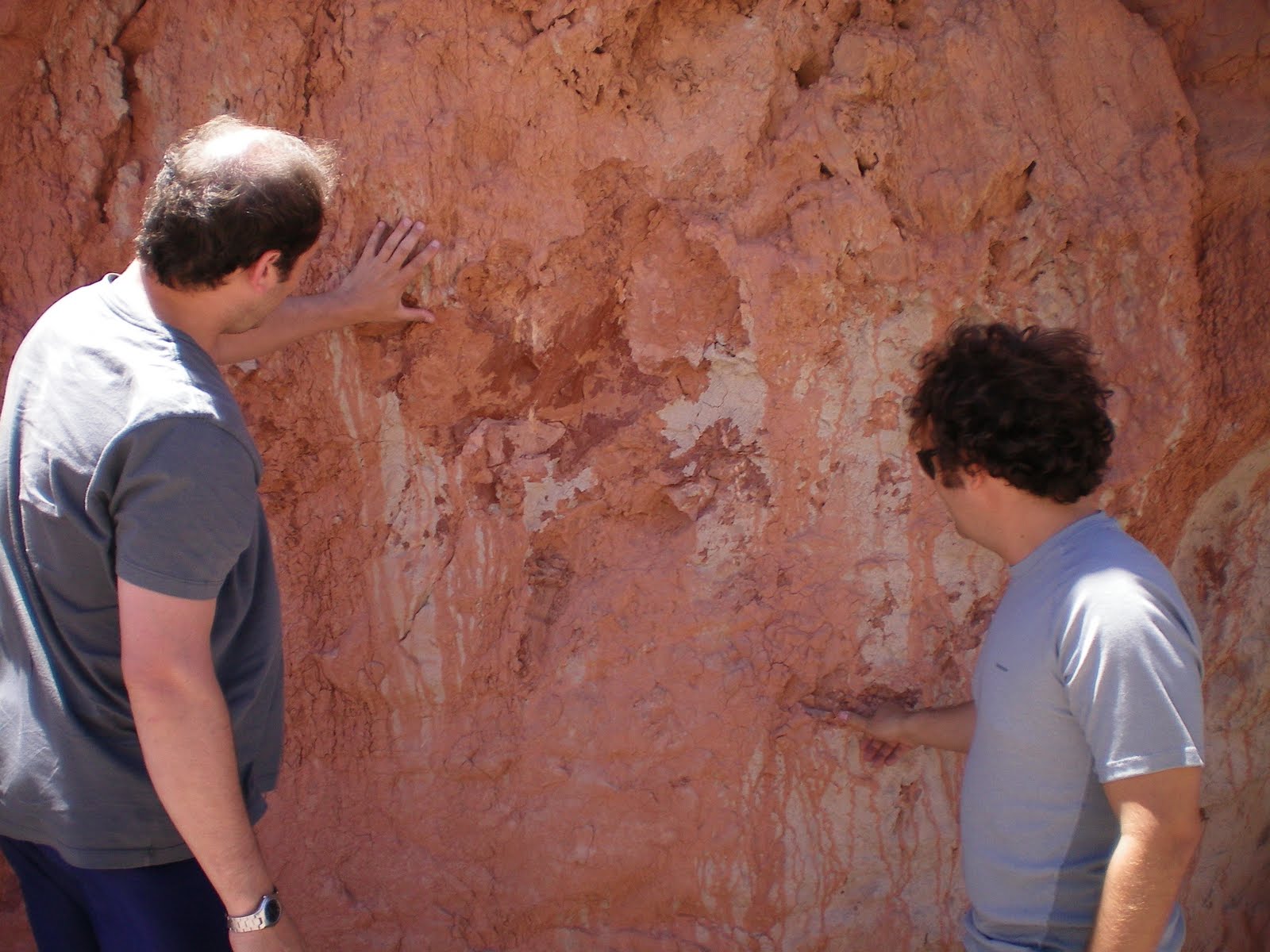
The first town that we visited was Purmamarca, a surprisingly unpretentious little town considering the geological jewel it sits upon. We drove on a dirt road that skirts the hill behind the town and marveled at the colors of the rocks. Seba showed us some natural and man made optical illusions.
This cliff, a natural optical illusion, looks like it is white underneath but has been covered with red mud from above. But in scraping the mud a bit we found that the red clay is the base, and who knows where the white streaks have come from.
I will let you determine how this man-made optical illusion manages to capture Pedro and I at different moments in time.
After leaving Purmamarca we continued north along the Quebrada de Humauaca to stay for a couple of nights in the town of Tilcara. Tilcara was once a sleepy little green oasis dotted with adobe houses. It's grown a bit in the 10 years since Pedro last camped there, but it is still a really pleasant town even if tourism has become the main business. Tilcara's principal draw is its large Pucara, the remains of a precolombian fortified city. The above picture shows some of the reconstructed buildings of the Pucara de Tilcara. It also gives you an idea of how dry the landscape is; one might think one was in the southwest.
For more pictures click here.

 Much of the city has been excavated and restored, particularly the sections on the mountainsides.
  Making our way up to the higher levels was like trying to find our way through an ancient maze, with the final reward being an incredible view of the valley and unexcavated areas of the city below. There are no massive monuments or temples, just chest-high walls tracing the footprint of a once urban area. The only sounds to be heard were those of the wind buffeting the mountain, and of distant Italians egging each other on to free climb a massive boulder in the heart of the ruins.
  I've somehow managed to mess up the formatting of this post, but rather than patiently re-upload pictures, I'll just assume that pictures are worth more than a thousand words. Since my posts are always less than a thousand words, my work here is done. By the way, the last two pictures are from the grounds of the Pachamama natural history Museum in the nearby town of Amaicha. The grounds are the work of a local artist (ie, not artifacts).