Friday, April 30, 2010

Cafayate: mmmm, wine.


Cafayate is a pretty little town that is an up and coming wine destination.  Think Calistoga but located in Utah.  The town is snuggled up to the Andes, which provides just enough water for vineyards.  They say grapes need poor soil -- well here they have it.

Pedro's brother Mariano was able to work his contacts to get us a tour of a very nice high-end winery called El Porvenir de los Andes.  We showed up at the winery at around 3pm in the afternoon and were met by the resident agronomist.   We hopped in her truck and she drove us 10 minutes south of town to tool around in the vineyards.  Driving amidst the vines she described for us the different varietals the winery grows, the ages of various vines, their qualities...a lot of fascinating stuff of which I cannot remember a single detail.  I need to keep a diary.  Or a blog.


In any case, my lack of memory with regards to the finer points of agronomy probably had something to do with the growing sense of anticipation;  we were going to taste the GOOD stuff.  After returning to the winery we were shown the production area, including the beaker-filled laboratory of the enologist (cool).  We then wandered past the display of antique barrels and into...da dum da da!!!  The tasting room!


In the tasting room we got to try all of the varietals of their Lavorum line,  possibly more... they were generous glasses, I didn't use the spitoon, lets say I lost count.


After Pedro, I and the lady conducting the tasting were all sufficiently drunk (around 6pm I think), we made one last stop.  The room where the winery keeps samples of each year's wines.  Pedro hopes to live there one day.


The next day we visited an indigenous reservation called Yacochuya.


It isn't heavily populated, but it was pretty to walk around in.


The cacti were in bloom.


And so was whatever festive plant this is.


We checked out the outside of the funky looking church -- it was locked.


We wandered by some picturesque houses.


The one woman we met invited us to check out her kitchen where she was frying empanadas over a campfire.  The kitchen was a standalone building separate from the house, with a hole in the roof to let out (some) smoke, and walls that appeared to be painted with tar from years of cooking.


One of the best small wineries in Argentina lies on land adjacent to the village.  The bodega is also called Yacochuya.


Although we didn't score a tasting (despite buying a very nice bottle of San Pedro de Yacochuya... taste untasted?)  we did convince the bodega manager to sneek us behind the owner's house to check out their little manmade waterfall.  I'm not sure why, it's a little weird in retrospect.


While in Calafate we also went on a hike in the hills behind the town.  We picked up a couple of hitchhikers on the way to the trail (it was roughly a bazillion degrees even at 6,000 ft elevation), and joined up with another couple of Europeans as we all searched for some sign of the alleged trail.  In the end an indigenous guide hanging out at the campground took it on himself to show us the way.


We originally wanted to hike to some waterfalls that the tourist office in town had circled on our map.  However our guide/companion convinced us that it was a hike best undertaken in the early morning before the earth had turned into a massive clay oven.


We went as far as some beautiful deep pools upriver.  I would have loved to go swimming in them (come on, I love to "swim" in the ditch next to the house in Eagleville, and look how this compares!), but unfortunately I didn't bring a swimsuit and our pesky companions would NOT wander off so that I could skinny dip.  Fie.

Wednesday, April 28, 2010

Quebrada de las Conchas, Salta

After a few weeks of sweltering in the 100 plus degree temperatures in northern argentina, unwilling to walk anywhere outdoors between the hours of 10am and 6pm,  I finally abandoned my insistence that "backpackers don't rent cars" and jumped on the Budget Rent-a-Car bandwagon.  This slick little 1.4 liter, 2 door Chevy Corsa became our chariot for a week, at the bargain-basement price of only fifty-ish dollars a day and around $60 per tank of gas.

Heading west from Salta capital, we passed by the Posta de los Chivos and the town of Alemania before we came to the main destination of the day; the Quebrada de las Conchas.  Literally the name means Ravine of the Shells, but unfortunately it's meaning in common slang is quite a bit more colorful, so in general these days it goes by the name Quebrada de Salta.

Here Pedro explains that although we have been known to "Pack, Climb & Ski" (granted never all at once), our preferred itinerary on this jaunt would be to "Drive, Park & Snack."

The Quebrada de las Conchas is geologically similar to the Quebrada de Humahuaca; it is a twisted jumble of brightly colored rock strata.  The elevation is a bit lower however, maybe only around 4-5 thousand feet or so, so driving through the ravine was much more relaxing.


The guidebook instructed us to drive eastwards in the afternoon in order to have the best views, but we decided heading westward midmorning was close enough.

One of the most notable rock formations is called la Garganta del Diablo (the Devil's throat).

Technically we weren't supposed to go beyond the first sandstone wall into the Devil's throat, but some returning frenchmen told us that with adequate footwear it was no problem.  Not wanting to return to the car to get my hiking boots, I decided that when they said "adequate footwear" they really meant a combination of flip-flops and bare feet.

I was a bit slower than Pedro, but luckily managed to continue on far enough....

...to be swallowed alive!!  Just like (not at all like?) when the Sand Monster tries to swallow the partially blind Hans Solo in "The Empire Strikes Back"!

Come on, if my glasses had fallen off, it TOTALLY would have been like that.


Monday, April 19, 2010

Post for Dad: Foamer stuff!

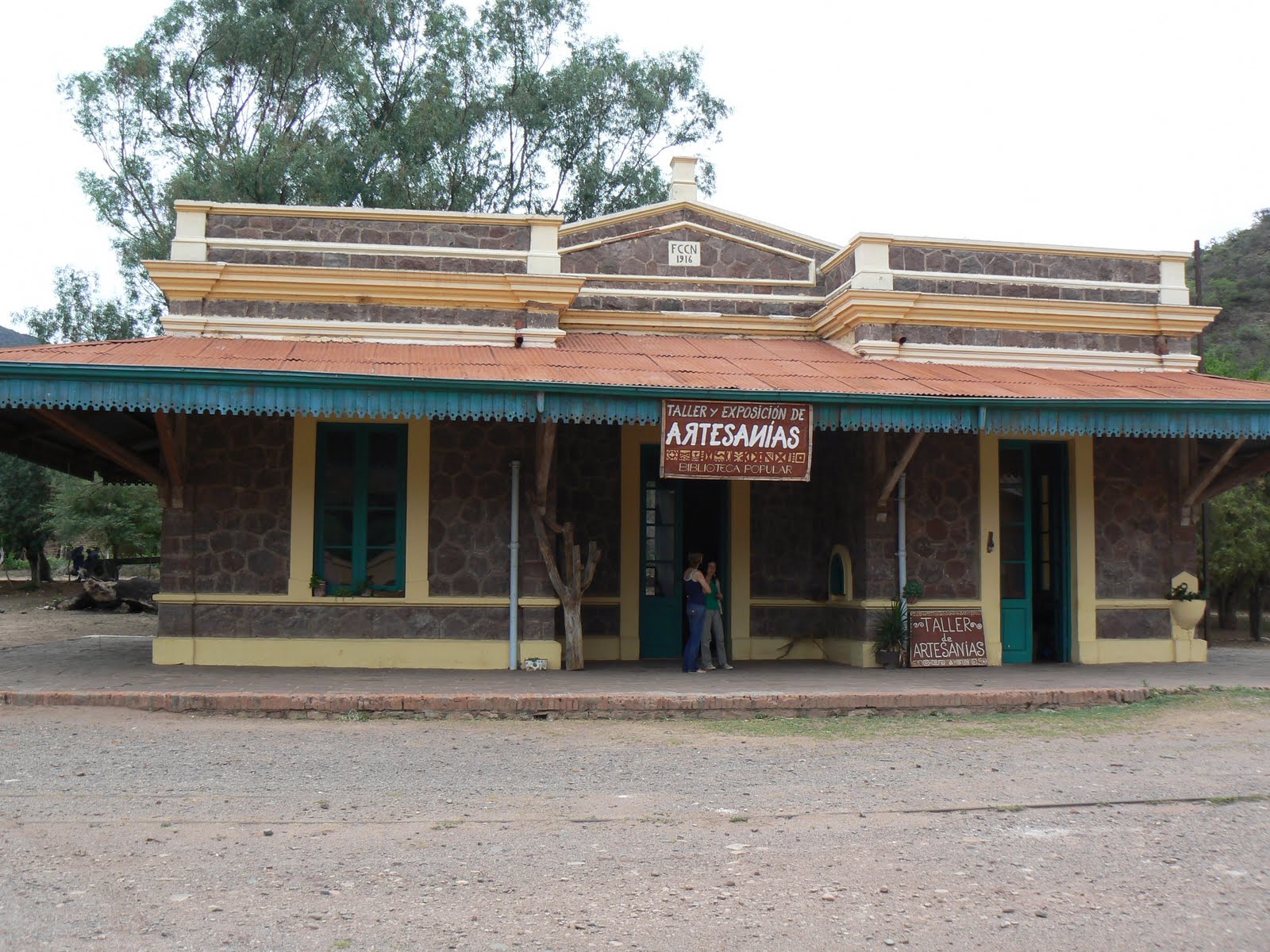
As Pedro and I headed west from Salta, capital, towards the Vineyards (and tasting rooms) of Cafayate, we stopped at the tiny town of Alemania.  It was once connected by train to the urban centers to the east, but now that the railroads have been abandoned there are only a handful of families who still live there.

The town in snuggled between red rocky hills covered in cactus.  The bridge into town was once a railroad bridge.


Dad, as you can see, we were thinking of you when we took these pictures.


The train station was built in 1916 and was recently  rennovated; it has a lot of cool architectural detail.  I chatted a bit with a woman who runs a craft co-op inside.  Apparently the town is in such good shape because a few years ago a thriller set in the U.S. southwest was filmed here.  The place does give off a ghost-town vibe; we saw only one person on the street while we were there.

Post for Grandpa: Goats!


Driving west from Salta capital, we stopped at a cute little tourist trap featuring goats.  Not sure what breed they were, but they were cute and climbed all over everything just like grandpa's goats.

Monday, March 29, 2010

Massive kitchen disaster


Recently I decided that one of the things I want to do with all my downtime back here in Buenos Aires is to learn how to make really good bread.  I’ve made 3 loaves so far with mixed to positive results.  The first loaf was a simple white French bread,  It had a nice texture, perhaps a wee bit dense but somehow with an awesome thick crunchy crust.  The next day it was still delicious, but I decided to change flour brands because the fragrance had just a touch of ode de grocery store.  Not overwhelming but who wants old musty flour.
My second loaf was an attempt at a multigrain French loaf that worked out pretty well too.  Cracked wheat with linen seeds, walnuts, and a brown glossy crust thanks to brushed egg on top.  Again just a wee bit dense.
Leveraging the same recipe, yesterday I started my third loaf.  I eliminated the all purpose flour from the recipe since the mass-market whole wheat down here appears to just be white flour with wheat germ mixed in.  I also let the bread rise overnight in the hopes that I’d get some nice air bubbles.  The results…eh.  The texture is a little lighter, but maybe the dough was too wet because the bread spread outwards instead of upwards.
These three loaves, however, are not the source of Pedro and my current misfortune.
My original idea around 5 days ago was to make sourdough bread.  But sourdough bread requires that I make sourdough starter, which is basically a awesome little biology experiment in catching wild yeasts on our kitchen counter using only flour and water.  The end result is supposed to grow into a beery-smelling little pet who, I discovered through extensive online research, many people name.
Our counter pet doesn’t yet have a name.  But it does have an odor.  One we discovered while taking out the trash today.
Part of the process of growing our pet is discarding half of it every day and feeding it new flour and water.  Being a conscientious person, I elected not to pour the goo down the drain for fear that it would turn into cement in some curve of the plumbing.  Instead I tossed portions of our pet into the trash, and since we normally take the trash out every day, I didn’t foresee any problems.  Except that yesterday we went to a barbecue.  So the trash can had bits of yesterday’s kitchen pet, to which I added more this morning.
A few minutes ago Pedro decided to take out the trash.  He opened the bin, and it smelled a little unpleasant.  Then he lifted the bag and was subjected to an unforeseen attack.  Apparently our pet decided to turn himself into a biological weapon.  There was a cry from the kitchen as Pedro was assaulted by noxious gases, then a frantic “Hurry, hurry, hurry!” as the brown pet-juice leaked through the seams of the plastic bag, burning the wretched smell into the floor.
Within the next few days our pet will have to stand trial; to decide whether he’s just too bad to ever turn good.  I don’t know where I went wrong in nurturing him, but only once before have I smelled something so foul.
In Miami I bought a cute mini pumpkin one Halloween, and set it on top of the tv as decoration.  There the cute little pumpkin stayed for around 9 months until my parents came for a visit and we for some reason decided to throw it away.  At the slightest touch, the little pumpkin suddenly melted all over the tv set, and the smell that filled the air was akin to a diaper filled by a baby who had had a wicked night of drinking the day before.

I had hoped never to revisit that day.  Shudder.

Salta: Salinas Grandes


One of the places that Seba drove us to was the Salinas Grandes de Salta.  Before you ask, the province name Salta has nothing to do with salt; salta is spanish for leap :)

Heading west out of the Quebrada de Humauaca we drove up up up to the Cuesta de Lipan (14,680 ft), gateway to the Argentine altiplano.  The altiplano is basically a wide flat plain at a bit over 11,000 ft elevation and stretching between eastern and western peaks of the Andes.  The Salinas Grandes are salt flats in what was once a lake.  The above picture captures the Salinas in the distance.

There is a small salt operation in the salinas, and the preparations for a somewhat bigger tourist operation.  On the side of the road it appears that someone is building a restaurant out of salt:


Next the the restaurant there was a turbo solar-cooker that I know that Mom will want to build as soon as she sees this picture.


I think a slight flaw in their business model is that the only thing on the menu out by the tables seems to be cat.


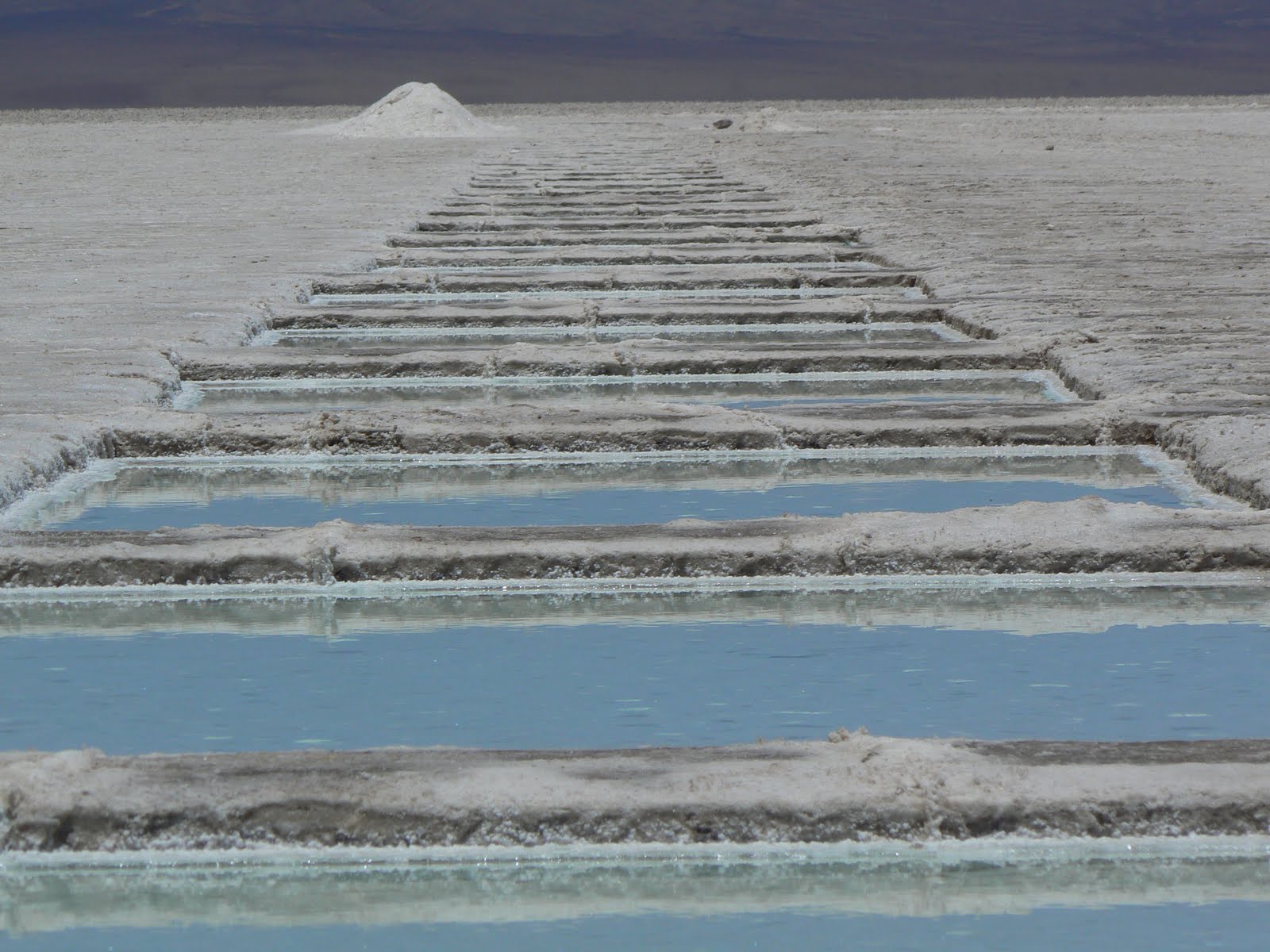
Opposite the "restaurant" we walked around the salt production areas.  Rectangular pools are cut into the salt-pan, salt is purified by the water and then shovelled into heaps to be carted away.


Seba and Pedro were arrested for trespassing and sentenced to 2 minutes hard labor.


My favorite part of the day, though, was the llama ride.
A few more pictures here

Saturday, March 27, 2010

Jujuy! La Quebrada de Humauaca

You've got to love a province that is called Jujuy (pronounced who-hooey).  The name is just fun, something you might yell at the top of a slide at Raging Waters.  But Jujuy has a whole lot more going for it than just a moniker that sounds like a giggle.  It has the mind-blowing Quebrada de Humauaca, a section of the Andes where God decided to take an impressionist approach to landscaping:

This is what the finished work looks like.  Actually, I should say that this is NOT what the finished work looks like.  The colors in real life are fantastically vivid and unfortunately amateur photography really can't do it justice.  Why not?

Let's say you're driving up a mountain road.  The surrounding mountains are vast and eerily shaded by deep gray storm clouds high above.  But, lo, off in the distance someone must have spoken, "let there be light."


To which you reply, "Light is great and all, but could we have a little less than Hiroshima perhaps?"


And a sad little dog chimes in, "I agee."


But I digress.  The Quebrada de Humauaca stretches north-south along the top of the province of Jujuy, which incidentally is shaped like a boot and shares a border with Bolivia.  Sebastian, an old college friend of Pedro's, spent a weekend driving us around it at breakneck speeds, impressing us not only with the awesomeness of nature but also the awesomeness of the Chevrolet Vectra's ability to defy inertial force.   Let's just say that coming out of every curve I had to blink several times in amazement.

The first town that we visited was Purmamarca, a surprisingly unpretentious little town considering the geological jewel it sits upon.   We drove on a dirt road that skirts the hill behind the town and marveled at the colors of the rocks.  Seba showed us some natural and man made optical illusions.
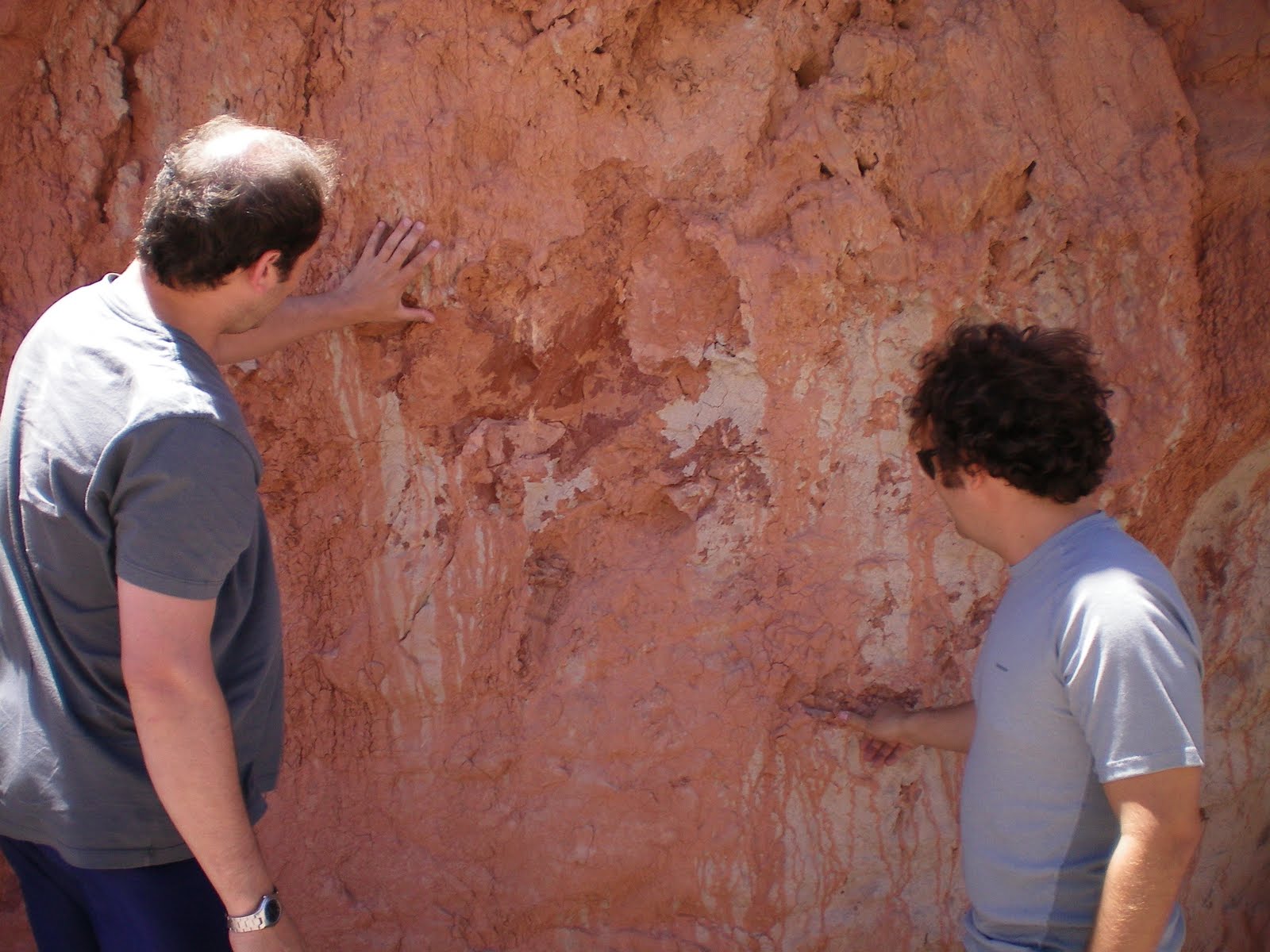
This cliff, a natural optical illusion, looks like it is white underneath but has been covered with red mud from above.  But in scraping the mud a bit we found that the red clay is the base, and who knows where the white streaks have come from.


I will let you determine how this man-made optical illusion manages to capture Pedro and I at different moments in time.

After leaving Purmamarca we continued north along the Quebrada de Humauaca to stay for a couple of nights in the town of Tilcara.  Tilcara was once a sleepy little green oasis dotted with adobe houses.  It's grown a bit in the 10 years since Pedro last camped there, but it is still a really pleasant town even if tourism has become the main business.  Tilcara's principal draw is its large Pucara, the remains of a precolombian fortified city.  The above picture shows some of the reconstructed buildings of the Pucara de Tilcara.  It also gives you an idea of how dry the landscape is;  one might think one was in the southwest.

For more pictures click here.